
By Globe News Report Staff
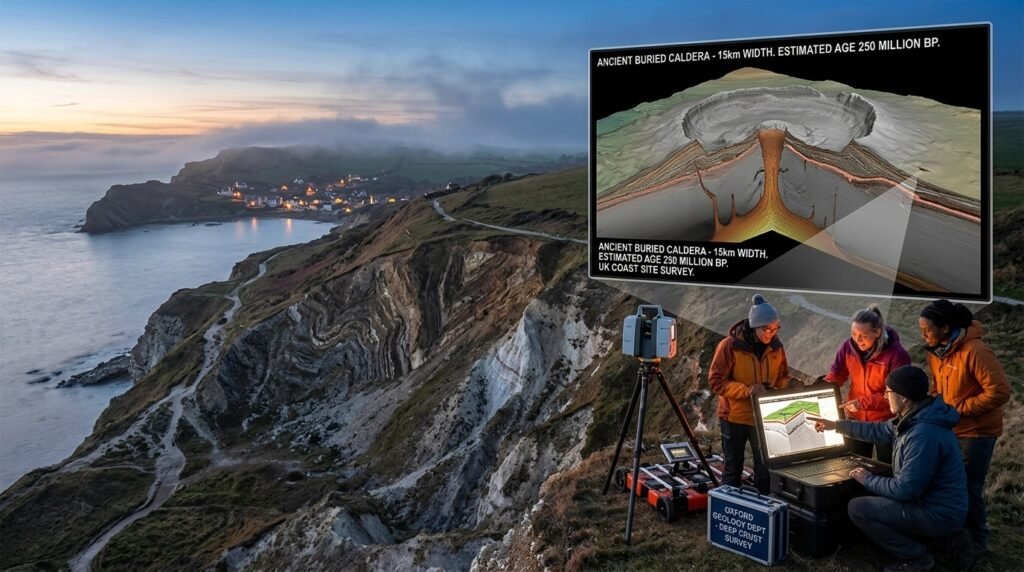
Scientists have found evidence of a massive supervolcano hidden deep beneath England’s east coast. It sits under The Wash and stretches into Norfolk and Lincolnshire. The volcano erupted around 454 million years ago. Its force was thousands of times more powerful than Italy’s Mount Etna.
A Long-Standing Mystery Solved
For years, scientists knew about a huge layer of volcanic ash spread across Norway, Sweden, the Baltic region, Belarus, and Poland. They just didn’t know where it came from. Researchers at the British Geological Survey and the University of Oslo have now traced it back to this newly found supervolcano in England.
The discovery came from studying tiny zircon crystals. Each one is about the width of a human hair. These crystals form inside magma before a volcano erupts. Uranium inside the crystals slowly turns into lead over time. By measuring that change, scientists could date the eruption precisely. Samples from Norfolk and Lincolnshire were drilled from boreholes 80 years ago. Those samples turned out to match in age almost exactly with volcanic ash found in Scandinavia.
Researchers believe ash from the eruption traveled across an ancient sea. That sea once separated England from Scandinavia. The ash eventually settled on the sea floor.
One of the Largest Eruptions in Earth’s History
The eruption threw hundreds of cubic kilometers of the Earth’s crust into the stratosphere. Its force compared to several thousand hydrogen bombs. It happened roughly 200 million years before dinosaurs existed. Scientists call a volcano a “supervolcano” if it has erupted more than 1,000 cubic kilometers of material. Only 30 such volcanoes exist in the world today.
There is no visible trace of the volcano on the surface today. Dr. Tim Pharaoh of the British Geological Survey said scientists had long suspected something unusual was buried beneath The Wash. That suspicion came from earlier geological surveys. But researchers lacked the tools to confirm it until now.
No Cause for Concern
Despite its explosive history, researchers say there’s no danger of it erupting again. Pharaoh explained that fault lines can become active again over time. An extinct volcano cannot. Once it goes dormant, it stays that way for good.
Jenni Barclay, a volcanologist at the University of Bristol, called the discovery an important step forward. She said it helps build a clearer picture of the UK’s deep geological history. She added that this kind of research also helps scientists better understand underground resources, like water and minerals.
Sources: Information for this report was gathered from the BBC and the British Geological Survey.